
Episode 63: SEVERAL SPACE UPDATES
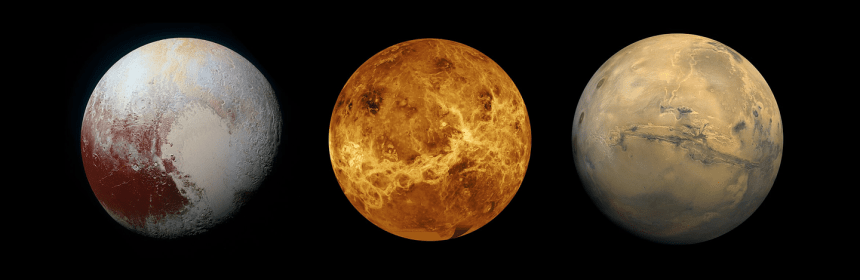
Image: Pluto, Venus and Mars (Source: NASA)
Our new episode is available from our Podcast host here: https://asabpod.podbean.com/e/episode-63
We’re also listed on:
Sources/Reading:
- Pluto
- “Pluto is a planet again — at least in Arizona” (NPR)
- “Pluto is the official state planet of Arizona” (Discover Flagstaff)
- History of Pluto (Lowell Observatory)
- Mathematical Discovery of Planets
- Venus
- Our previous episode: “Episode 9: Phosphine? In Venus’s Atmosphere? It’s More Likely Than You Think”
- “Source of phosphine on Venus—An unsolved problem” (Frontiers in Astronomy and Space Sciences)
- “Controversial phosphine findings on Venus corroborated” (Chemistry World)
- Mars
- “Curiosity Rover Spots Ancient Water Ripples on Mars, Hinting at a Past With Shallow, Ice-Free Lakes” (Smithsonian Magazine)
- “Is Planet X Real?” (NASA)
Also I cut it from the episode, but Tessa has a cat now! Now both hosts of this podcast have a demanding and affectionate grey and white cat.
Transcript
Charles 0:24
Hello and welcome to Assigned Scientist at Bachelor’s. I’m Charles and I’m an entomologist.
Tessa 0:29
And I’m Tessa and I’m an astrobiologist.
Charles 0:32
I wanted to talk about a couple of topics that I saw recently that have happened in the time between our last episode and now, regarding space and the wonders therein. So what I’d love to do first is just to ask you if you are particularly excited about anything that has happened in the past two years.
Tessa 0:50
A big thing, and we’re going to talk about this a little bit later, is that we’ve got several new telescopes coming online, including the Vera Rubin telescope down in, I believe it’s in Chile, which is part of a project that will take a high resolution image of the entire night sky every three days, and is going to really revolutionize what we know about the solar system and also about how distant galaxies are moving. So that’s very cool. And the other thing is, NASA has already started working on designing the next space telescope to come after James Webb, the Habitable Worlds Observatory, and yours truly was on one of the sub teams that was doing the science design for the mission.
Charles 1:28
Wow! That sounds a little bit sarcastic, but it was 100% genuine.
Tessa 1:34
Oh, no, I know.
Charles 1:35
That’s that’s actually very impressive and very cool.
Tessa 1:38
It’s literally the sort of stuff I wanted to do like, since I’ve been 12, so.
Charles 1:43
You were, you – came out of the womb, just a huge nerd.
Tessa 1:47
Yeah, oh yeah.
Charles 1:52
There are a couple specific topics that I’m hoping that you can tell me, and also the world a little bit more about. The first is, I only learned about this very recently – turns out it happened sometime in 2024 but Arizona officially named Pluto as our state planet.
Tessa 2:10
I’m actually kind of surprised they didn’t do this sooner, since Arizona has always had a strong feeling of ownership Pluto, since it was discovered by an observatory in Arizona, the Lowell Observatory up in Flagstaff.
Charles 2:23
And And we’ve talked before about how there are multiple significant observatories in the boundaries of what the United States government considers Arizona, including the Lowell Observatory, but I know that there are also observatories like near Tucson, and I believe the reason for this is that the sky is just so gosh darn clear.
Tessa 2:45
Yep, yep. Low humidity means that you’ve got much better observing conditions, much more frequently.
Charles 2:51
Yeah, like, the same phenomenon that leads to us having a UV index –
Tessa 2:57
Yes
Charles 2:57
– in the afternoon of like, 13 in July.
Tessa 3:00
Unfortunately, yes, that, but yeah, this is the one positive to that.
Charles 3:04
I hope you’re wearing your sunscreen. I’m wearing my sunscreen.
Tessa 3:07
Oh, you better believe it.
Charles 3:08
Well, I think there are a lot of interesting things about the story. The first is that Pluto was such a late discovery, and it was only in 1930 that Pluto was identified and named as a planet.
Tessa 3:19
And the funny thing is, the reason they were even looking for Pluto in the first place was actually due to a physics error. Neptune was discovered in 1846 so you know, it’s been known about for a comparatively longer period of time. However, its orbit was just ever so slightly off based off of what was predicted. Now, this was not a huge shock to astronomers at the time, because to them, this meant that there was another planet out there. In fact, the reason Neptune had been discovered was because Uranus’s orbit was slightly different than what’s predicted. In fact, Neptune was mathematically predicted quite a bit before it was actually visually observed. So they figured, oh, okay, well, there must be another ninth planet out there that is messing with Neptune’s orbit.
So Clyde Tombaugh, who’s the guy who discovered Pluto, was part of a campaign at Lowell Observatory to scan the skies to try to find this ninth planet he discovered Pluto. However, later on, in fact, in 1989 when the Voyager spacecraft went past Neptune, we… it was discovered that we had been underestimating its mass by about half a percent. And they were able to figure this out based off of how the Voyager spacecraft changed velocity as it slingshot-ed around Neptune, and once you factor that in, the weird orbital perturbation goes away.
So it turns out there was no ninth planet messing with Neptune’s orbit, and that’s a good thing, because Pluto is way too small to be having the effect that was being seen on Neptune’s orbit. It’s, it is a tiny, little planet, and interestingly enough, for a hot second when before they actually confirmed how small Pluto was, but they knew it must have been very compact, because otherwise it would be a lot brighter. A physicist and science fiction writer by the name of Fred Hoyle suggested that it was basically an artificial structure. This like super compact, super massive torus of like some sort of hypothetical ultra dense matter that was rotating very quickly, because if you flew a spaceship through the center of the torus, it would safely accelerate you to an appreciable velocity of the speed of light. And that basically some, and this was all mostly in jest, but he was speculating, oh yeah, you know, maybe some alien civilization, like, you know, shot this at our solar system for us to be able to use later as, sort of like a gateway to the stars. Obviously, it’s not the case. But, you know, points for creativity. Once you know Neptune’s actual mass, this discrepancy goes away, and you don’t need this hypothetical ninth planet, but we still found Pluto anyways.
Charles 6:00
How… I always worry what I want to ask about space, that it’s gonna come out as, like, you absolute cretin. But how does, how? How do they even know how to estimate a planet’s mass?
Tessa 6:15
That’s actually a very good question. Um, because,
Charles 6:17
Because here’s my thing, because here’s my thing – it’s far away, and it’s big.
Tessa 6:22
Yeah, it’s actually, it is quite a challenge, and this is why they didn’t figure out what Neptune’s mass was correctly until Voyager went by. In order to really do it properly, you have to have another object orbiting it, usually a moon. In fact, for example, we didn’t know what Pluto’s mass was until they discovered that it has a moon, Charon, and the way you do it is basically by looking at how long it takes that object to orbit the planet, and how far away it is from the planet when it’s orbiting, you can do some math to figure out what the mass of the two objects are. So the big planet and the moon, and this is sort of like the basis of orbital mechanics, but yeah, in order to do it, you need to have a moon orbiting, or satellite or something, something you can observe orbiting the planet.
Now, Neptune had moons, but they are, for the most part, very, very small compared to the planet. One exception is Triton, and Triton has a very weird orbit. Anyways, they actually think it was a planet like Pluto that may have gotten captured later, and because of that, they weren’t able to estimate the mass of Neptune as accurately as they would like.But yeah, it’s basically you send something in orbit around it, and then you can do math based off of how long that orbit takes and how big it is.
Charles 7:37
I will say, I think physicists, and you can tell them I said this, I think sometimes physicists get too superior about things, but I will say one cool thing about physics is that the history of physics does involve a lot of these like, Well, we think, based on everything we see around it, in the math we’re doing, that there’s this thing, and then they do find that thing.
Tessa 7:50
Yeah, yeah. You know, credit where credit’s due. They’re pretty good at doing projections.
Charles 8:06
Physics is – and listen, don’t let it go to your head. But physics is pretty cool.
Tessa 8:11
It has its moments.
Charles 8:12
But don’t let it go to your head. So, yeah. So I found this very interesting. As you said, it seems like this would have been the thing that, like somebody in the 1970s would have been like, let’s get Pluto in here as our official planet. It’s it struck me as very strange.
Tessa 8:27
Yeah.
Charles 8:27
The timing of doing it in 2024.
Tessa 8:30
Yeah. I’m not really sure why it took that long. But what surprised me is the controversy of over whether Pluto is a planet or not. That happened 2006 so, I mean, that’s still 18 years before when they officially made it. So, you know, even if it was like them, you know, boosterism for the hometown planet like you figured, they could be a bit more timely about it, right?
Charles 8:49
But what is really interesting to me is, what surprised me the most is that I thought that this was like a straightforward, just straightforward dunk against… look how ridiculous our state legislature is that they still have this, like, reactionary pro-Pluto… like the the jokes about, like, RIP Pluto, we still support Pluto. Like, those kind of got old by 2009.
Tessa 9:12
Yeah, yeah.
Charles 9:13
Conservatively. So I thought that this was gonna be a straightforward dunk through the hoop. Who cares about Pluto? Get over it, you bunch of sissies. But as it turns out, the ruling in 2006 was not completely uncontentious.
Tessa 9:28
Oh yeah.
Charles 9:28
In that…
Tessa 9:30
It was very controversial, even withinin the scientific community.
Charles 9:32
Well, why don’t you talk about that more?
Tessa 9:34
Because, yeah, so basically, the major motivation for even considering decategorizing Pluto as a planet was because we discovered objects that were very similar to Pluto out there. Uh, Sedna, Makemake, these very distant, very small, icy bodies that were definitely, you know, not just asteroids, they were bigger than that. And the concern was basically, well, if Pluto is a planet, then all those are planets. And then you end up with, like, having 50 planets in your solar system potentially. And I guess that bothered some people, because they don’t want to have that many planets to keep track of. I guess, honestly, I think it’s that’s just a skill issue, personally.
Charles 10:12
You have to come up with a much longer mnemonic device.
Tessa 10:16
Sure, but, I mean, like, you know you’re a taxonomist who studies beetles, you’ve got, you know, more than just eight, nine beetles to keep track of.
Charles 10:25
[jokingly] How dare you insult me. I’m not a beetle specialist. I’m a cockroach specialist.
Tessa 10:29
[playfully] Oh, my mistake. I should have been more specific.
Charles 10:32
Unbelievable.
Tessa 10:33
But still, you know, I’d imagine there’s more than just eight species you have to keep track of, and somehow you manage. So, you know, clearly the planetary scientists can just deal.
Charles 10:42
Correct.
Tessa 10:43
Anyhow, that was the original motivation for it was just, oh no, we’ll have too many planets. And so the International Astronomical Union, which is the body that, I guess, officially, names and classifies objects in our solar system, had this very like year long contentious debate over, should we still consider Pluto a planet or not?
And you know, there were arguments made that well, one of the classic definitions of whether or not you have a planet or you have an asteroid is that a planet is big enough that its gravity forces it into a sphere. Because if you throw enough mass in space, eventually the most gravitationally, I guess, for lack of better term, efficient shape for it to assume, is a sphere, because it’s being pulled towards the center at all angles, on all sides, you know, with the same force. So that, you know, in Pluto, is clearly spherical.
There were debates about, Well, is it large enough that it’s undergone some degree of differentiation? That is, it has, you know, sort of a crust and a core, and maybe, you know, an ocean or a mantle or something in between the core and the crust. They didn’t know that back then. We do know that now, it is differentiated, and but even then, back then, it was suspected.
Charles 11:58
How do we this is, again, we get into they’re big and they’re far away. How do we know… Because we haven’t land, obviously, we haven’t landed anything on Pluto. How do we know the like structure of Pluto as an object?
Tessa 12:11
To some degree, it’s conjecture. However, we, you know, when you know the New Horizons probe came by, if I recall correctly, it had radar on it so it could penetrate into the surface somewhat, also based off of very minute variations in the gravitational field of the planet, which you can measure literally by just seeing how fast or slow the spacecraft goes by the planet. You know, if the gravity is a little bit higher, it’ll go a bit slower. If it’s a bit lower, it’ll go a bit faster. You can get a sense for what the internal structure of the planet is like. Again, there’s still some degree of conjecture, but at the very least, you can rule out a lot of possibilities and sort of narrow it down that, okay, it’s not slowing our spacecraft down very much. Therefore, you know, it’s probably not very dense. Probably doesn’t have a rock, a lot of rock in it. It’s probably mostly, you know, water, ice or ices of some form or another, because it’s very cold there.
Charles 12:49
Okay, so a lot of what we know about objects like Pluto that we can’t physically go to and be like we’re going to do a crust survey, is sending objects out into space and having tools on them, and it collects some amount of information, and then using the information – like how it behaves in terms of gravitational pull – making reasoned conclusions based on what we would expect. So it’s not direct physical sampling. It’s like, we’re going to observe how objects interact with this from space, and then make conclusions based on that, based on how we understand the laws of physics in general.
Tessa 13:44
Yeah, that’s pretty much it.
Charles 13:46
Okay, great.
Tessa 13:47
Based off of that, you know, what most planets look like, there are people making arguments, No, we should keep Pluto as a planet. And yes, it means we may have to consider some of these other bodies that we found, like Sedna, to be planets as well, but you know, we’ll deal with that when we get there pretty much.
And the argument that was made against it was that, well, okay, but another thing that planets have as a characteristic is that they have cleared their neighborhood, which is a weird metaphor for saying basically, they are so big that random cometary debris that might have been in their orbit has been swept out. Basically, it’s either fallen onto the planet or it’s been ejected by the planet’s gravitational field, which is why, you know, we don’t worry about, like, comets slamming into the Earth every other week or whatever. I mean, there are other reasons for that too, but part of it is that Earth has cleared its neighborhood. They, you know, soaked up all the debris billions of years ago, so we don’t have to worry about anymore – great.
Pluto, as far as anyone can tell, has not. There’s still a lot of other random debris out there that intersects with its orbit. And probably because it is such a small planet, is why it hasn’t really removed most of this debris, the way that, say, Jupiter has. So that was, like, one of the most convincing arguments that the side that was demoting Pluto was making and it ultimately ended up being the one that led to its demotion.
And again, part of it was also just people didn’t want to deal with the idea of having, like, 20 planets in the solar system, which, as we’ve discussed, is merely a skill issue. But hey, I don’t run the International Astronomical Union. What do I know that was why they ultimately decided to demote Pluto. But like I said, there was a lot of debate, and there were even people within the community saying, okay, yes, we acknowledge it hasn’t cleared its neighborhood, but for historical reasons, we may want to consider it to be an honorary planet. And again, because it was so contentious, I am surprised that the government of Arizona did not like weigh in on it when it was happening and not 18 years later.
Charles 15:20
The timing did strike me as very odd. It was interesting to me that it was like… it wasn’t even something… There was a quote from one of the articles that I read that was like the, um, the IAU? Is it the…
Tessa 15:54
Yeah, International Astronomical Union.
Charles 15:56
That the decision was even made after most of the like, specifically, planetary scientists had already gone home. That was…
Tessa 16:04
Yeah.
Charles 16:04
It was presented as is, like, not so scandalous, like they did, they did it after all the guys who actually knew what was going on left – gender neutral “guys.” But I think my, my big takeaway was, like, I came to the news like, this is a straightforward dunk on the state legislature, you bunch of bozos. Obviously, it’s not a planet. And then I came away with it – and let it never be said that I’m a totally closed minded individual – thinking, Oh, it turns out even planetary people aren’t totally decided one way or the other.
Tessa 16:37
That makes sense, because, like at its core, this is a question of taxonomy, and I’m sure, as you know, there can be subjective opinions and aspects of how taxonomic categorizations are made.
Charles 16:49
Yeah, I think that is what’s interesting the most to me, somebody whose background is in taxonomy is… and not to get political, although, I mean, come on. But there is so much about people refusing to acknowledge…
I saw a Tiktok reposted to Instagram, because, again, I’m not on Tiktok. People want to believe that biology functions in dichotomies, but in fact, biology functions in spectrums and even things that seem extremely straightforwardly dichotomous, like male or female as sexes, it turns out, actually, there are a lot of variations in development that result in like… even putting aside other species for whom a male/female dichotomy straightforwardly doesn’t make any sense, even looking at humans, if you actually get right down to it, there are always going to be people who don’t perfectly match the like, quote, unquote, intuitive common sense characterizations.
And similarly, even within physics and astronomy, etc, etc, there are these cases where observed phenomena don’t neatly slot themselves into discrete categories, and the way that we talk about them ends up being less about, this is a straightforward distinction between this kind of thing and that kind of thing, and it’s more the decisions that we make around categorization are always going to be impacted by the uses that we have for that categorization system. So like, whether something is a planet may come down to, well, how do we want to treat these objects and like, how do we want to talk about them? How do we want to study them? How do we want to teach them to people?
Tessa 18:36
Right, exactly.
Charles 18:41
Here’s another topic that I wanted to bring up. A little over four years ago, we did an episode on the supposed – we’ll get into it -discovery of phosphine in Venus’s atmosphere, and I was hoping that we could talk about where that is now. But before we get to that, Tessa, could you maybe refresh everybody’s memories on why that was important in the first place?
Tessa 19:03
Basically people analyzing spectral data from Venus’s atmosphere – that is, by studying the light shining through Venus’s atmosphere from the sun and then seeing what bands of light were absorbed, you can figure out what the different molecules in the atmosphere are. People have done that sort of spectroscopic analysis of Venus’s atmosphere and also compared it with data from space probes that got sent back in the 70s and 80s. That’s a similar analysis, except they were actually on the planet instead of just looking at it through a telescope. Said that they might have detected phosphine, which is this compound of phosphorus and hydrogen.
And it got everybody very excited, because here on Earth, phosphine is exclusively produced by biological processes. There is not any non-biological process that’s known to create it. And this got people very excited, because the weird thing about Venus is that even though the surface is utterly uninhabitable to any form of life that we would currently know of or recognize, because, you know, it’s hot enough to melt lead, and the atmospheric pressure is hundreds that of Earth, if you get up to about 70 kilometers above the surface, it’s actually one of the most earth like places in the solar system, in that the temperature is warm, but like not impossibly so, and the pressure is about what you’d see on Earth. And this has led people to speculate that there could be like, microbes living up in the clouds at that altitude, and that maybe this phosphine was being produced by them.
Charles 20:34
And then I saw last year, I believe there was a publication that was like, actually, you all got duped. There’s no phosphine up there.
Tessa 20:43
Yep. This has been an ongoing fight ever since it has been argued that either A, they were seeing the spectral lines of a different gas, I believe, of some like sulfur molecules, or that B, there is phosphine there, but there are ways to produce it, non-biologically, involving volcanism and some other weird processes or C It was just an artifact of the data, and none of it was real to begin with. And this fight is still going on.
Charles 21:10
This may be something. This may be a question with no real answer, but given that this was based on spectral data, and apparently there’s some controversy over whether that’s reliable in the way that the original publication presented it. Why… I’m gonna pose a question like I’m a person who doesn’t know anything about anything, which is not far off from the truth. But why don’t we just send some kind of a spacecraft to directly sample Venus’s atmosphere?
Tessa 21:39
They are actually planning on doing that! Like, um, not only is NASA planning on sending one, possibly two, orbiters to Venus, there is a mission in the works that is funded by a private consortium of universities and businesses that is going to basically send a rocket type probe that will skim through the atmosphere and then go back up into orbit and analyze what it finds. Because, yeah, that would be the ultimate way to actually detect if there’s actually anything living there, or if there’s even phosphine.
Charles 22:13
Was this planned mission at all inspired by the finding four years ago, or is it just coincidental?
Tessa 22:20
Oh no, it was primarily motivated by it.
Charles 22:22
Okay.
Tessa 22:23
Yeah, it’s the Venus life finder, also known as Morning Star, and it’s being developed by Rocket Lab, which is a, as the name suggests, a company that builds rockets, based in New Zealand, and a team from MIT.
Charles 22:35
So enough people find the finding of phosphine on Venus –
Tessa 22:40
Yes.
Charles 22:41
Plausible enough…
Tessa 22:43
Yeah, that it’s worth sending a probe to. I also, correction, they aren’t going to send a rocket that’ll skim the atmosphere. That’s a different project. This one is much simpler. It’s just going to be essentially a balloon with a little probe attached to it that they’re going to drop into the atmosphere. But it’s, you know, still same idea – sending something actually down there to see what’s there.
Charles 23:02
How are they going to get the balloon back?
Tessa 23:04
Oh, they aren’t, not for this one.
Charles 23:05
Then how are they going to get the data?
Tessa 23:08
Oh, radio transmitter.
Charles 23:10
Okay!
Tessa 23:11
It’s not going to be so down in the atmosphere that it won’t be able to send back messages. It’s going to be high enough up.
Charles 23:18
So there’s something… so the balloon is attached to a thing.
Tessa 23:21
Yeah, it’s got a probe hanging off of it, and that will…
Charles 23:24
And the probe will be able to analyze…
Tessa 23:26
Yep.
Charles 23:26
Like, the composition of the gasses that…
Tessa 23:28
Specifically, they’ve got a bunch of fluorescent spectroscopy analysis, basically gonna see if anything lights up if you shoot a laser at it.
Charles 23:35
Man, the things that humans have accomplished.
Tessa 23:37
Yeah, and in part, they’re doing that because organic molecules, like, you know, DNA and chlorophyll and some other ones, tend to be fluorescent, so it’s a good way of telling if there’s anything growing there.
Charles 23:51
I mean, I guess it gets to a sort of a broader question that I imagine that astrobiology and similar fields get hit with a lot of… it seems like a lot of the work that is done is based on just by necessity of not being able to physically send people to go and sample things and look at them with their own human eyes and be like, This is what’s happening… In the way of phosphine… Because on Earth, phosphine is only produced via organic processes. Then the thinking that phosphine…
This is what I’m saying, is that the sort of the reasoning of, well, on earth, we only know phosphine from organic processes. So, if we see phosphine elsewhere, that is likely, or potentially, indicative of life as a process happening elsewhere, and then it feels like it’s very open to the criticism of, well, we only know phosphine from organic processes here, but the Earth is not a comprehensive representative of all possibilities in the universe.
Tessa 24:56
Yeah, exactly. And I mean, that is always something we run into as a risk. The good news is that we’ve gotten better as time has gone on, of like mitigating that, of being more open minded and speculative about well, just because phosphine here is produced entirely by a biology, we shouldn’t necessarily assume that’s the case everywhere. Honestly, that is the thing, one of the things I really like about this field is that it challenges you to be as sort of imaginative as can be as a scientist, because you kind of have to be, otherwise you’ll fall into those traps. But yeah, the downside is, as you say, you know, we do have limitations on what we can do, since it’s pretty difficult just to send a person there, and we usually have to make do with what data we can get back from these space probes or from these telescope observations or what have you.
Charles 25:48
Yeah, so the final thing I wanted to bring up is something that I only just barely heard about. I’m hoping that you know more about it than I do, but I saw some news reports suggesting that, I think in the past there had, there’s evidence that there was open water on Mars.
Tessa 26:04
Yes, that just came out recently, and I don’t know the full details, but it’s been something that’s been speculated for a while. It’s just they found more evidence. I believe it was due to some of the minerals that they found, one of the rovers found, which basically only will form if you’ve got, like, open water for the minerals to precipitate out of. And like, you know, it’s been suspected for a long time that there was standing water on Mars. There probably was rain at one point as well. It’s been theorized that actually, the whole northern hemisphere of Mars, which is relatively smooth and not covered in Meteor craters the way the southern hemisphere is, may have been one giant ocean. People said they might have found like the remnants of shorelines, but so yeah, you know, this wasn’t exactly a shocking discovery, but it was cool to have sort of confirmation of what people theorized for a long time.
Charles 26:56
Why, why was it theorized for a long time?
Tessa 27:00
Well, we know that Mars had flowing water on at one point or another, because, you know, we see these like river channels that have been carved out from even from orbit. However, there was arguments about, oh, well, maybe, you know, that was just like an aquifer under the surface that, you know, breached and sort of exploded outward, and then, you know, the water very quickly froze or evaporated. You know, it wasn’t there for any length of period of time.
However, a lot of the geological evidence, in terms of sort of the rocks that they were finding, again, suggested that you had water standing around long enough for erosion to happen and for sediment to be deposited and eventually deposited into sedimentary rock like we see on Earth, which, again, is produced pretty much only with processes using liquid water. You know, shale is just like sand and silt that has been deposited by water and then compressed and heated until it turned into rock. And they found sort of similar compounds like that on Mars. They, for example, found a lot of where one of the early Mars exploration rovers landed, they found, like these little cereals of sort of iron compounds that, on earth, anyways, pretty much only occur in water. So again, like I said, it had been suspected based off of these surface features and based off of the rocks they were finding, but I think now that you know what they found now is sort of like really conclusive evidence that, oh, yeah, this could have only happened with large amounts of open water.
Charles 28:26
And so the significance of this is, A, I assume, cool, and then B, I think we’ve talked about this before, and to some extent, the excitement over water in other planets and other, you know, planet like objects in space, is the excitement over the discovery of open water on Mars at all related to thinking that this could have been related to life on Mars?
Basically, it’s more evidence that Mars was, early in its history, much more similar to Earth than it is now in that it had large amounts of water. It had a much thicker atmosphere. It was a lot warmer. So because, I mean, the water was liquid and not frozen, an environment that where you may not necessarily be able to breathe the atmosphere, because, you know, there’s probably still wasn’t a lot of oxygen. You could at least walk around without wearing a space suit, you know, you just need, like, an oxygen supply, and you’d be good to go, as opposed to now, where, you know you have to deal with freezing and, you know, having bruising form on your skin due to lack of atmospheric pressure and a whole bunch of other really unpleasant stuff. So that is basically why everyone gets excited about this, that you know this, okay, Mars had oceans like Earth, did you know, and that wasn’t always assumed.
Interesting. From your impression, is there a lot of hope that we might find evidence of life on Mars, or is it still a very…?
Tessa 29:52
I would not be surprised if we find life on Mars. We still, we know for a while now that there are seasonal plumes of methane that show up in the atmosphere, which is weird, because the easiest ways to make methane are either through life – that’s where most of the methane on earth comes from, is bacteria producing it – or from a geological process called serpentization, which is basically the transformation of like one type of rock into another. However, that also requires liquid water in large quantities in order to happen.
So you know, either way, that is suggested that there are environments somewhere on Mars that are warm and wet, which is what living stuff tends to enjoy inhabiting. Whether or not we’ll find fossil evidence, which is something people have speculated on that, you know, it since Mars was much more like Earth early on in its history, maybe they’ll find fossilized bacteria, or even, you know, the equivalent of sponges, or something that I don’t know, but I do think it is entirely possible that there could be still life on Mars, and that at the very least, there may have been life there early on in its history.
And also I looked it up, and apparently the big discovery was that they found these mounds of clay, essentially, which, again, on earth, pretty much all the clay we had comes from water interacting with rocks. So that makes sense that people would be excited about it.
Charles 31:20
This actually is a great segue into another thought that I was having, which is, we should renew our like end of episodequestions.
Tessa 31:29
Mm, yes.
Charles 31:30
And so I’ve been cooking up a new one, that is – I have a very easy answer to, but I think this will present a real mind journey for you to go on. So let’s say hypothetically, we find …this is some point – his is a near future scenario – we find strong but not conclusive evidence that there may have been life on Mars, and you can apply to go on a mission to Mars to look into it, but the mission is through a private company that is headed by a figure like, or it could be, El-n M-sk.
So basically, you have an opportunity to go to Mars to look for evidence of life on Mars, but ,you’re not going through NASA, you’re not going through, you know, an international space coalition, you’re not going through any sort of reputable, non-profit kind of organization. You specifically have the option of going on a mission headed by or otherwise owned by El-n M-sk – would you go?
Tessa 32:43
Great question.
Charles 32:45
Because my answer is straightforwardly, absolutely not. I’m not going to go to space.
Tessa 32:49
Yeah, but we already knew that.
Charles 32:51
I was born here and I’ll die here, and in between, I’ll be here.
Tessa 32:55
I… It depends. If it’s El-n M-sk himself, and he’s very much involved in it, I would say no, because, based off of the success of the cyber truck, I don’t trust any spacecraft he’s building to actually make it to Mars.
Charles 33:10
Yeah.
Tessa 33:10
With that said, if it was headed up by someone who I actually thought could build a working spacecraft, I would be honestly tempted to go, but I would spend the entire time bad mouthing whoever it is. Because, I mean, I’m on Mars. What’s you gonna do, fire me?
Charles 33:25
Well, I mean, there are worse things that can… I mean, this is the thing. Labor Law is only as strong as the agencies that enforce it, you know what I mean?
Tessa 33:34
Oh, yeah, I get that. But I mean, the worst thing you could do is withhold my pay, and I wouldn’t be worried about that, because, you know, I could just make money doing lectures as the woman who found life on Mars, potentially. And I mean, again…
Charles 33:47
I mean, I will say that I think the worst thing that can happen is that they will push you out of the spacecraft and you’ll die in space.
Tessa 33:53
Oh, Okay, gotcha. Gotcha. I… so he has his thugs on the mission. If that’s the case, I probably would not go, because I wouldn’t trust the trust them.
Charles 34:01
Well, I’m not even saying thugs. I’m saying that if you’re on Mars… it would be very easy to kill somebody on Mars and make it look like an accident.
Tessa 34:09
I guess the the answer to that is that I would not go because I would not trust the crew. You know, if I’m gonna go all the way to another planet, I want it to be with people who I actually believe have my well-being in mind, otherwise, it’s not going to be a fun time.
Charles 34:25
Right, so El-n M-sk is like a particularly bad person to go on a mission with – or on behalf of – because he is famously…Well, first of all, Nazi. Second of all, overall kind of an incompetent who has –
Tessa 34:38
Oh, yeah, he doesn’t know anything.
Charles 34:40
– an exaggerated sense of his own competence and intelligence. But if it were just, like, if it were just a privatized mission of, like, some billionaire who’s, like, bad because he’s a billionaire, but like, not famously, outrageously bad, then it would be more of a, yeah I’ll go.
Tessa 34:56
Yeah, yeah. It would be tempting. But again, it would also depend on the crew and how much latitude we’re given, like…
Charles 35:02
Right.
Tessa 35:03
If I felt like the people on the mission had more loyalty to whoever this billionaire is than to the actual mission and getting already back alive, I would not go, because there’s no way that’s going to end well.
Charles 35:15
Right. Well, I mean, you have a wife and a cat to think about.
Tessa 35:17
Yeah, exactly. You know, I do as much as, as cool as Mars is, I would also like to be able to come back to Earth.
Charles 35:24
I mean, it’s the… I mean, Earth is the best.
Tessa 35:26
Yeah, it does have cats. And, you know, that’s important.
Charles 35:29
It has cats and it has insects.
Tessa 35:31
It does have insects, yeah.
Charles 35:33
No… This is a thing, no other planet – that we know of – has insects. So no no other planet is really worth your time at the end of the day.
Tessa 35:43
Yeah, yeah, at least until we find one that has insects on it. But, you know, until…
Charles 35:47
Well, I mean, this is the thing is that… this is the argument that taxonomists would get into.
Tessa 35:52
Would it count as an insect?
Charles 35:53
They wouldn’t, yeah, they wouldn’t count as insects. Because the, the sort of the formalized system of taxonomic organization that we have now in is based on phylogenetic relationships. If they evolved independently on Mars –
Tessa 36:09
Yeah, can’t do it.
Charles 36:10
– it’s an insect-like organism.
Tessa 36:17
One more note, bit more cheerful. Remember how I mentioned, oh, that they predicted that they’d find Neptune by looking at these orbital perturbations that Uranus was having, and then they thought they’d find Pluto based off of these perturbations in Neptune’s orbit? Well, there… that is still something that is happening, but it’s not with Neptune. Instead, they found a whole bunch of body of small icy objects, kind of halfway between Pluto and comets in terms of size. So, you know, little dinky icy bodies, way out beyond Neptune, we’re talking like 250, times the distance from the Earth to the Sun. So way, way, way out there.
And they found that their orbits tend to cluster together an awful lot, more so than you would expect. You would expect to see them sort of randomly distributed throughout the solar system. While there’s some speculation that this just could be due to random chance or observation bias, and that these objects are easier for us to observe, and that’s why we’ve been finding them, it’s just they were the easiest to find – but there has been speculation that there actually could be the sort of mythical like ninth, or, depending on you count it, tenth planet out there, you know, that is much closer to the size of, say, Earth or Neptune, than to Pluto. And that’s what’s causing these, like, orbital clusters.
That is still very controversial. People have been looking for it. They haven’t found it. With that said, the telescope that I mentioned earlier, Vera Rubin, which is going to take, you know, these high resolution images on the entire night sky every three days for like, a year, possibly longer, they are expecting that if that planet exists, that telescope will find it. So hopefully, within the next two to three years, we will know if there is another planet in our solar system.
Charles 37:59
Wow, what a world. I mean this is assuming that in two to three years, we aren’t casualties of the water wars.
Tessa 38:05
Yeah, yeah, yeah. I’m being optimistic right here, and also the telescope’s in Chile. So whatever is going wrong here is unlikely to affect it at least immediately.
Charles 38:14
Hopefully things are going better than they are here.
Tessa 38:17
They are, from what I’ve been told.
Charles 38:18
Okay, well, that’s good. Hopefully I’m gonna get this edited and published within about a week, but just in case anybody’s lacking context on the maybe higher than average sense of pessimism, the inauguration in the United States was six days ago.
Tessa 38:34
Yeah, it was not a good time.
Charles 38:40
Well, now it’s segueing into – if people want to find me online, don’t. I’m not on Twitter anymore. I don’t use Twitter. I haven’t used Twitter in a long time. But Assigned Scientist at Bachelor’s is on blue sky. We are A-S-A-B-pod dot, all the stuff you have to put in for blue sky and Tessa, where can people find you?
Tessa 39:00
I can also be found onto the sky at Tessa Fisher dot bsky dot social. However, to get like better info, you can also go to my website, tessafisher.com
Charles 39:10
And the podcast still has its website, asabpodcast.com.
Tessa 39:16
And until next time, keep on science-ing.
 Assigned Scientist at Bachelor's