
Episode 64: Blood-Eating Mosquitoes, Mosquito-Eating Spiders
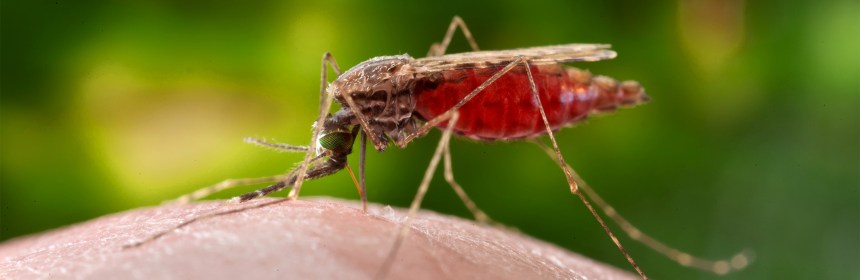
Image: Female Anopheles merus engorged with blood (Source: CDC).
Our new episode is available from our Podcast host here: https://asabpod.podbean.com/e/episode-64
Sources/Reading:
- Evolution and hematophagy
- “How deep is the conflict between molecular and fossil evidence on the age of angiosperms?” (New Phytologist, 2019)
- “How Did Insects Evolve To Feast On Your Blood?” (Popular Science, 2014)
- “Hemoglobin-derived porphyrins preserved in a Middle Eocene blood-engorged mosquito” (PNAS, 2013), summarized here
- “Evolutionary origins of the blood vascular system and endothelium” (Journal of Thrombosis and Haemostasis, 2013)
- “Chapter 14 – Translation of Saliva Proteins Into Tools to Prevent Vector-Borne Disease Transmission” (2017)
- Hematophagous insects
- “Triatomines (Hemiptera, Reduviidae) blood intake: Physical constraints and biological adaptations” (Journal of Insect Physiology, 2017)
- “Saliva of hematophagous insects: a multifaceted toolkit” (Current Opinions in Insect Science, 2018)
- KISSING BUGS & CHAGAS DISEASE IN THE UNITED STATES (Texas A&M)
- Evarcha culicivora
- “A spider that feeds indirectly on vertebrate blood by choosing female mosquitoes as prey” (PNAS, 2005)
- “The discerning predator: decision rules underlying prey classification by a mosquito-eating jumping spider” (Journal of Experimental Biology, 2012)
- “How blood-derived odor influences mate-choice decisions by a mosquito-eating predator” (PNAS, 2009)
- “The Functioning of Species-Specific Olfactory Pheromones in the Biology of a Mosquito-Eating Jumping Spider from East Africa” (Journal of Insect Behavior, 2012)
- Publications that came out after we recorded this episode
- “Mate choice as a third context in which a mosquito-specialist jumping spider attends to red-coloured cues” (Royal Society Open Science, 2025)
- My favorite places to buy seeds
Transcript
00:00:23 Charles
Hello and welcome to Assigned Scientist at Bachelor’s.
00:00:26 Charles
I’m Charles and I’m an entomologist.
00:00:28 Tessa
And I’m Tessa and I’m an astrobiologist.
00:00:31 Charles
I, to pay the bills and for the love of the game, I am also a fact checker.
00:00:38 Charles
And in my capacity as a fact checker, this year I had reason to research whether there are any organisms which are specialists on mosquitoes.
00:00:51 Charles
Essentially looking at the question of why can’t we just eradicate mosquitoes?
00:00:57 Charles
Right?
00:00:58 Charles
And part of the aspect of that is the fear potentially that if we eradicate mosquitoes, we would disturb sort of the general ecology around mosquitoes too much, because many different organisms do eat mosquitoes.
00:01:11 Charles
But then the question is, is there anything that eats mosquitoes to the exclusion of anything else?
00:01:17 Charles
And as far as I can tell, there is no documented organism which, if we eliminated any given species of mosquito, would be left nutritionally derelict.
00:01:33 Tessa
Gotcha.
00:01:34 Charles
However, I did find one jumping spider, Evarcha culicivora, which is a specialist on and particularly wants to eat not just mosquitoes, not just Anopheles mosquitoes, but specifically female Anopheles mosquitoes, which have taken a blood meal.
00:01:59 Tessa
That is very weirdly specific.
00:02:03 Charles
When I was reading some studies about them, I got very interested in hematophagy, which is blood eating, and the evolution thereof, and sort of the underlying, why would the this spider be so specific on female mosquitoes that have taken a blood meal?
00:02:25 Charles
We begin with the very concept of hematophagy. That word, “phagy” – p h a g y – is just used for eating, right. In entomology, we talk about all these different diet adaptations that different groups of insects have.
00:02:42 Charles
So you have xylophagy, which is eating wood, you have phytophagy, which is eating plants, you have saprophagy, which is eating like dead and rotten stuff.
00:02:51 Charles
And you have hematophagy.
00:02:53 Charles
In hematophagy, it’s basically just eating blood, right? And so probably the most famous and arguably the most important hematophagous insects are mosquitoes.
00:03:03 Charles
I would make the argument that mosquitoes are in fact the most medically important animal in the world.
00:03:08 Tessa
I think that tracks. Yeah, yeah.
00:03:11 Charles
I’m ertainly not alone in making that argument, many people have made that argument.
00:03:14 Charles
Hematophagy is just eating blood, and this is something that has evolved many different times in arthropods.
00:03:21 Charles
I think some sources I saw saying it had evolved in like 20 different lineages independently from each other.
00:03:29 Charles
And by evolving independently is some kind of adaptation or lifestyle or whatever appearing in different lineages of organisms, not from a single evolutionary origin point, but instead appearing like in that lineage over there and in that lineage over there, a bunch of different times with no… not because of each other, but just by coincidence, really.
00:03:55 Charles
I think by coincidence, by people in the know, in evolutionary biology, I think could be a point of some amount of contention in the sense that oftentimes similar adaptations emerge in unrelated lineages of organisms because sort of the starting position, they had traits available to them that kind of set the stage for very similar adaptations.
00:04:23 Charles
Does that make sense?
00:04:24 Tessa
Yeah.
00:04:24 Charles
But we’re not in philosophy of biology right now, we’re in the podcast Assigned Scientist at Bachelor’s.
00:04:30 Charles
I got interested in the origin, the evolutionary origin point of hematophagy.
00:04:34 Charles
There are a couple of different, as far as I can tell, sort of major hypotheses as to what exactly those sort of origin grounds of, like, why did these specific lineages develop hematophagy?
00:04:48 Charles
Like, why was that something that they were in a position to develop relative to other ones?
00:04:53 Charles
And it’s, I mean, it is very varied because so many different lineages have developed hematophagy and because they have developed it in different ways.
00:05:03 Charles
So one source I found through a dichotomy between telomophagg and solenophagg, where one is pool feeding, which is something that happens in, for instance, tabanid flies, like deer flies, horseflies.
00:05:19 Charles
They don’t have piercing and sucking mouth parts, they have, like, knife mouth parts.
00:05:25 Charles
They will cut the skin and then they will lap up the blood from there, versus, quote, vessel feeding, which is probably the more sort of commonly imagined one, particularly because it more easily lends itself to vampire comparisons, which is, this is what we see in mosquitoes, it’s what we see in bed bugs, where they have piercing and sucking mouth parts where they pierce through the skin and then suck out the blood.
00:05:57 Charles
So the exact evolutionary origin point of blood feeding is hard to pin down because of the sparseness of the fossil record and the need to often rely on indirect signs… like fluids are not typically preserved very well over millions of years, regardless of what we all learned from Jurassic Park.
00:06:13 Tessa
You’re telling me that Michael Crichton lied to me?
00:06:16 Charles
Unfortunately, yes.
00:06:17 Charles
And also then, Steven Spielsberg, you were lied to by multiple people over many years.
00:06:24 Charles
I did actually see one source say that mosquitoes, contrary to Jurassic park, are not usually preserved in amber, but instead in shale, which I guess is not as sexy as preservation in amber.
00:06:38 Charles
And particularly relying on amber for an idea of what prehistoric insects look like is always going to…
00:06:47 Charles
I mean, the problem with the fossil record and the fossilized and preserved and petrified in whatever record, it is always going to be heavily discriminatory towards organisms that were more likely to hang out in the environments that produce those conditions.
00:07:04 Tessa
Right, no, that makes sense.
00:07:05 Charles
You’re not going to see insects that don’t ever hang out on trees preserved in sap.
00:07:10 Tessa
Yeah.
00:07:11 Charles
But the good news is that we do have an absolute ceiling on how early blood, blood feeding could develop, which is the evolutionary origin of blood itself.
00:07:21 Charles
That said, I was shaken to my core today.
00:07:26 Charles
Absolutely, it destroyed my whole worldview for a couple of minutes where I was like, well surely insects are older than vertebrates.
00:07:34 Charles
Obviously, because insects are better than vertebrates and we’re more important than vertebrates.
00:07:39 Charles
Duh.
00:07:40 Charles
But apparently the earliest vertebrates are older than the earliest insects.
00:07:45 Tessa
I would not have guessed that.
00:07:47 Charles
Well, in retrospect it seems very obvious because the earliest vertebrates were fish and insects are overwhelmingly terrestrial.
00:07:59 Charles
Like going back to the time of the earliest fish there were arthropods.
00:08:04 Charles
Arthropods are very, very, very old.
00:08:07 Charles
But ocean insects are…
00:08:12 Charles
Well, this would be a controversial, but basically our understanding of insect evolution now is that they are a clade within Pancrustacea.
00:08:24 Charles
So crustaceans as we think of them are actually a paraphyletic assemblage.
00:08:28 Charles
So like the ocean, like the, the prehistoric, ancient, early fish equivalent to insects, humans are to the earliest vertebrates as insects are to like really old crabs.
00:08:42 Tessa
Huh.
00:08:42 Charles
And, and, and nobody direct me quote me on that because I don’t actually know exactly when crabs developed.
00:08:47 Charles
But like early, early crustaceans, this is what I’m saying.
00:08:50 Charles
So like in retrospect it’s very, it’s very obvious that vertebrates came before insects because the earliest vertebrates were fish in the ocean.
00:09:01 Charles
Insects typically don’t live in the ocean in the same way that mammals characteristically don’t live in the ocean.
00:09:07 Charles
Except for the mammals who live in the ocean.
00:09:08 Charles
Insects characteristically don’t live in the ocean except for like a couple of insects.
00:09:14 Charles
And I’m talking the real ocean, not along the shoreline, I’m talking the ocean ocean.
00:09:21 Charles
Really the only like deep diving insect species that exists are parasitic lice that like live on deep diving pinnipeds.
00:09:30 Charles
All that to say is my whole, my whole worldview was shaken this evening.
00:09:35 Charles
It seems like the sort of the, the modern like blood vascular system in vertebrates began around 400 million years ago and then was firmly established in mammals and birds 200 million years ago.
00:09:49 Charles
And estimates of the earliest blood feeding in arthropods place at about 150 to 200 million years ago, which is younger than insects themselves, who are about 400 mil confirmed, about 400 million years old from the fossil record.
00:10:04 Charles
And then this is where I got into a real tangent about angiosperms, because I said, but still older than flowering plants.
00:10:11 Charles
And then I had to fact check myself on how old flowering plants are.
00:10:15 Charles
And it seems like the time that will generally be given to you is that it emerged, flowering plants emerged and proliferated during the Cretaceous.
00:10:25 Charles
But there was one study that was published like 10 years ago which documented, quote, “angiosperm-like pollen” that would have… about 250 million years ago.
00:10:36 Charles
And I started getting really into the stated controversy over the actual age of flowering plants.
00:10:43 Charles
And then I realized that it wasn’t really related to anything that I wanted to talk about at all.
00:10:48 Charles
All that said, I’ll include some papers that I was looking at about the controversy over the actual origin point of angiosperms.
00:10:55 Charles
Anyway.
00:10:56 Charles
So the evidence for multiple independent origins, not only between broadly diverging lineages like triatomine bugs, which belong to the Hemiptera versus mosquitoes, which are antiptera, versus ticks, which aren’t even insects, but instead arachnids.
00:11:09 Charles
So the evidence for these multiple independent origins relies on numerous sources of data.
00:11:14 Charles
I mean, just beyond sort of the parsimony argument behind multiple independent origins, which I don’t know that the importance of the concept of parsimony in systematics and phylogenetics is accessible outside of people who care, arguably too much about systematics.
00:11:32 Charles
But basically the idea of parsimony is just that… It’s like kind of the Occam’s razor of biological systematics, of thinking the simplest evolutionary hypothesis for all of these different ways that organisms could evolve is probably the most likely one. So parsimoniously, if we think about hematophagy, for it to have a single evolutionary origin to encompass all of the diverse hematophagous lineages that we see in the true bugs, in lice, in true flies, etc.
00:12:08 Charles
There would have had to be a lot of other lineages that subsequently lost and evolved different feeding strategies.
00:12:15 Tessa
Right.
00:12:15 Charles
And that just simply doesn’t make sense.
00:12:18 Charles
But the way that we can more, even, even more than that, we can look at superficially, a lot of hematophagus groups have some apparent similarities.
00:12:28 Charles
Like, for example, most of them have piercing, sucking mouth parts, because that’s just kind of the, the most straightforward way to get to blood because you got to get through skin, right?
00:12:38 Tessa
Right.
00:12:39 Charles
You got to get through some stuff and then you gotta suck it back out like a straw.
00:12:43 Charles
So superficially, they have some clear similarities, but on a molecular level, the actual, like, genetic markers associated with their specific adaptations for hematophagy, and then things like specific salivary enzymes which allow them to take a continuous blood meal.
00:13:01 Charles
Because if you think about it, organisms which have blood like us typically have mechanisms to stop continuous blood flow, for example, blood coagulation.
00:13:11 Charles
This is why hemophilia is such a problem, because once you start bleeding, you just kind of continue bleeding.
00:13:17 Charles
Whereas for those of us who are not hemophiliacs, if you open up a cut, at a certain point, that cut is gonna close, your blood is gonna coagulate, and it’ll stop coming out of your body, and then it’ll grow a scab, and then you can pick off the scab.
00:13:32 Charles
If you’re me and you’re eight and you get a lot of scabs and you love picking scabs.
00:13:37 Charles
So, like, there we can go in and identify specific structures in their salivary enzymes and stuff are distinct between these different lineages, showing that they have superficially, you know, evolved towards the same thing in sucking up blood from vertebrates.
00:13:55 Charles
But the tools and their toolbox of how they are able to do that, both in, like, salivary enzymes to prevent coagulation, et cetera, as well as in adaptations in their gut to be able to digest and supplement missing nutrients, are markedly distinct between these different groups, which I found very interesting.
00:14:16 Charles
And I will include several papers talking about these kinds of differences in our sources.
00:14:26 Charles
Because then you end up on the question of, why bother drinking blood at all when you can do other stuff, right?
00:14:33 Charles
And the answer, as put it in one paper that I read, quote, “at the core of hematophagy is the reward of a meal rich in various nutrients, essential for the vector to mate, reproduce and increase its population.”
00:14:46 Charles
And this is relevant in that oftentimes, particularly in mosquitoes, if you get bit by a mosquito, that mosquito was female, because they, male mosquitoes, do not take blood meals at all.
00:15:00 Charles
You get the females who drink blood because they are tasked with a more energetically costly part of reproduction.
00:15:07 Charles
They don’t go through, you know, pregnancy, but they are producing and laying eggs.
00:15:13 Charles
And the way that it was taught to me, the way that I have taught it to other people, is that typically we think of blood drinking in insects as a means of having a very nutrient rich source of energy for this very energetically Costly part of reproduction in laying eggs.
00:15:33 Charles
But this is not a universal among all hematophagous arthropods.
00:15:38 Charles
So there are hematophagus arthropods which consume blood both as immatures and matures.
00:15:44 Charles
For example, bedbugs, nymphal bed bugs drink blood. Adult bedbugs also drink blood.
00:15:50 Charles
And then you also have, for example, in the bugs in bed bugs and then also in Triatomine bugs, which is a tribe of true bugs in the family Reduviidae, which are the assassin bugs.
00:16:02 Charles
Triatomine bugs are our tribe or a subgroup of reduviids. They’re responsible for spreading pathogen, responsible for Chagas disease.
00:16:12 Charles
So lower on the ladder of like medically important hematophagus insects.
00:16:17 Tessa
Still pretty unpleasant though.
00:16:18 Charles
So I specifically looked, I was like, do both male and female Triatomine bugs drink blood?
00:16:23 Charles
And the answer is that yes, they do.
00:16:25 Charles
But at least one study that I found specifically looked at this and found that although both males and females take blood meals, females take more blood.
00:16:35 Charles
So there’s still kind of a maintenance of this discrepancy between male and female, where even if they’re both drinking blood, females are potentially still taking more because of the aforementioned more energetically costly role in reproduction.
00:16:55 Charles
And so then we get to this idea of specifically Evarcha culicivora. If you are familiar with taxonomy or I guess Greek and Latin root words, you could look at the name for Evarcha culosivora without any other context and immediately know that it ate mosquitoes.
00:17:12 Charles
Because breaking down the species epithet here, Culicivora, the first part, culica-, refers to the family name for mosquitoes, which is Culicidae.
00:17:23 Charles
And then vora is of course for eating things, which may be more known to our audience as…
00:17:30 Tessa
Yeah, I was just thinking that.
00:17:32 Charles
The same root words, you know. Evarcha culicivora specifically eats mosquitoes. And more than just eating mosquitoes, it is, it is particularly interested in eating Anopheles mosquitoes, which, those are the malaria ones, so pretty bad.
00:17:46 Charles
Evarcha culicivora specifically, it has a pretty limited geographic range.
00:17:51 Charles
So part of their preference for Anopheles may be overlapping range of like Anopheles are particularly, particularly common in that area that you will find Evarcha culicivora.
00:18:01 Charles
But multiple studies have also shown a marked and specific preference for mosquitoes, for female mosquitoes, for specifically female mosquitoes who have taken a blood meal.
00:18:13 Charles
So a study on them from 2005 demonstrated that it, in their words, chooses specifically female mosquitoes that have recently fed on blood, when the alternatives are lake flies, other arthropod species that do not carry blood, male mosquitoes which never feed on blood, and female mosquitoes that have been feeding on sugar alone instead of blood.
00:18:31 Charles
And the Evarcha culicivora belongs to the family of spiders known as Salticidae, which are the jumping spiders.
00:18:37 Charles
Salticids are interesting for a number of reasons, but among them is their big eyes. They have… I think six eyes overall.
00:18:44 Charles
They have smaller side eyes, but they are particularly seen as being especially attractive and charismatic spiders for people who…
00:18:52 Tessa
They are awfully cute.
00:18:53 Charles
They are awfully cute. And it is because they have this pair of big round eye central to their head that gives them a very familiar looking face for, you know, a very appealing aspect for humans who are used to empathizing with organisms which have a single pair of big eyes in the middle of their face.
00:19:11 Charles
Which, you know, I think we should all get past that, but whatever.
00:19:14 Charles
Hardwired evolutionary responses to faces, blah, blah, blah, blah.
00:19:18 Charles
So this 2005 study was partly looking at whether the species has a specific preference for bloody feeding by means of mosquitoes as well as looking at vision based prey preference.
00:19:27 Charles
But this is not an episode about arthropod visual systems. But suffice it to say it’s- salticids in general are interesting in looking at how arthropods identify and discriminate between different sources of food.
00:19:43 Charles
Usually we think of arthropods as having at least, you know, relative to us, relative to us with our big fancy vertebrate eyes, having weak and particularly non high detail resolution vision.
00:19:56 Charles
But multiple studies have used salticids and multiple studies specifically have used Evarticula sephora to look at the idea of whether and how and how much these spiders can discriminate between different prey options and whether they are able, whether they are able to visually identify their preferred thing to feed on, which is female mosquitoes which have taken a blood meal.
00:20:19 Charles
Looking at that, the studies that have been done have found that Evarcha culicivora can distinguish between blood fed female mosquitoes and between female mosquitoes who are not carrying blood.
00:20:30 Charles
So different researchers have looked at how specific can we identify this preference down to, is it just female mosquitoes in general in the hopes that they will have had a blood meal. Is it mosquitoes in general?
00:20:43 Charles
And they have repeatedly found that Evarcha culicivora individuals do actually discriminate between male and female conspecifics and between females who have and have not recently taken a blood meal.
00:20:56 Charles
And so the exact means that they are able to do this is not 100% clear, but there is also strong evidence that there is a visual component in that they can in some way somehow identify female mosquitoes that have been engorged with blood from taking a blood meal.
00:21:14 Charles
And at least one study found that they it’s a hierarchical kind of preference system where above anything else they will go for blood fed female mosquitoes and then they will go for female mosquitoes over male mosquitoes, etc.
00:21:28 Charles
Which implies quite a sophisticated system available to Evarcha culicivora in the ability to identify both visual markers of a mosquito having taken a blood meal and in implied in the preference for female over males.
00:21:46 Charles
Even in this case of both females and males having been fed on sugar, still the higher likelihood of getting an indirect blood meal from feeding on a female mosquito, right, because male mosquitoes never take blood meals, they just fundamentally they are not able to.
00:22:01 Charles
And another study also found that there was some aspect to having taken a blood meal that made Evarticulos evora more like sexually appealing to opposite sex conspecific individuals.
00:22:16 Charles
That is, male spiders more attracted to females who had eaten a mosquito that had been fed with blood as well as females more attracted to males who had eaten a mosquito that had been fed with blood.
00:22:27 Charles
But I tried looking into this more because I think there are interesting implications there potentially for, you know, if we think that for example, we see a discrepancy in male versus female blood feeding in directly hematophagus arthropods on the basis of the nutrition value of blood, particularly for energetically costly reproduction. Is there something there for also Evarcha culicivora?
00:22:53 Charles
But as far as I can tell, a, there hasn’t been like really substantial investigation of this after that point, which fair enough.
00:23:01 Charles
And another study I found kind of questioned the idea whether it was like an oral olfactory cue from having fed on mosquitoes that did it.
00:23:09 Charles
So it seems like this particular aspect is still kind of unresolved.
00:23:12 Charles
Of course I will include in our notes, in our show notes, relevant studies looking at this question.
00:23:17 Charles
And so ultimately the interesting thing here is that first of all, there is at least one species that has a specific, documented, experimentally tested and demonstrated preference for, for mosquitoes who are medically significant to humans.
00:23:38 Charles
And it is a fascinating example of spiders really don’t have the mouth parts that would… spiders, they kind of have a sucking and piercing system, but in some aspect they don’t have sort of all of the mechanics in place to directly take blood meals.
00:23:58 Charles
And so this, a species of spider has nevertheless evolved such that they can take advantage of the evolution of direct hematophagy in other organisms.
00:24:09 Charles
And that’s pretty good.
00:24:15 Charles
That is what I have to tell you about hematophagy and Evarcha culicivora.
00:24:20 Charles
And before we leave, I would love to revisit one of our classic episode ending questions because I have an update to my answer for one of them.
00:24:31 Charles
Specifically our discussion question on what you would be doing in like a post apocalyptic landscape.
00:24:39 Charles
I want to clarify specifically because sometimes I feel bad about this.
00:24:42 Charles
In a way, you and I are already living in a post apocalyptic landscape insofar as European contact and colonization of this continent was effectively an apocalypse level event.
00:24:55 Tessa
Yeah, yeah. I mean, we’d wiped out 90% of the population. It’s pretty apocalyptic.
00:25:00 Charles
Yeah. Although I will say that I did do some fact… that’s another controversy in exactly what percentage of the people who were here before, what percentage of people were killed.
00:25:11 Charles
But I think getting caught up on the specific number kind of obscures the point, which is that it was almost unparalleled in its devastation.
00:25:21 Charles
So specifically in our discussion question, talking about sort of if we were in like a sci fi novel post apocalypse going forward from this point of human history, what we would be doing on like the survivor’s compound.
00:25:34 Charles
And previously I felt pretty bad because I don’t, I don’t really have any particularly useful skills.
00:25:40 Charles
Like if I were a plumber, I would feel great about myself.
00:25:43 Tessa
Right.
00:25:44 Charles
And what I could offer to our survivor commune.
00:25:47 Charles
But I finally, I got into gardening.
00:25:50 Charles
Not ornament, I’m not gardening ornamentals.
00:25:53 Charles
I’m growing crops.
00:25:54 Tessa
You can keep us all fed.
00:25:55 Charles
I, I can contribute to the food growing apparatus, especially because if we were all the, like, if the water wars happen tomorrow, I am, I’m basically trying to grow plants that are well suited to our environment, which in some that are not as much because sometimes you just want to eat broccoli.
00:26:16 Charles
You know what I mean?
00:26:16 Charles
I am specifically, and this is just a plug for anybody who is, who lives.
00:26:21 Charles
I mean really anybody who lives anywhere, but particularly if you live in zone 9B like I do and like you do, that’s already in A zone 9B.
00:26:31 Charles
There is an organization down in Tucson called Native Seeds/SEARCH.
00:26:37 Charles
They run a seed bank of heirloom and some wild varieties that have been growing in the Sonoran Desert for decades, if not several hundred years.
00:26:49 Charles
And so far, basically all of the seeds that I have used have come from them.
00:26:53 Charles
And they’re all really good and they have a big garden – I follow them on Instagram – and every Friday they do an update on their garden.
00:27:00 Charles
And it’s very exciting.
00:27:02 Charles
Alan’s sounding off about how exciting our plants are. [cat meows in background] But basically they have a big garden and they grow crops in the garden and then they save seeds from them. ith the idea being that it is generally recommended to grow, if you can, to grow seeds in your garden from plants that have been grown in similar environments.
00:27:25 Tessa
Right, which makes sense.
00:27:26 Charles
Of course. And so I have mostly used seeds from them, and it’s been very exciting.
00:27:32 Charles
Anyway, so in conclusion, basically, I am developing my capacity for gardening and my knowledge of plants, and I’m gonna be out there in the… I mean, if it’s a nuclear apocalypse…
00:27:45 Tessa
If it’s a nuclear apocalypse, we have bigger things to worry about.
00:27:48 Charles
We have bigger things to worry about because nobody has a basement.
00:27:51 Tessa
Yeah, yeah.
00:27:52 Charles
Where are we gonna go?
00:27:54 Charles
But if it’s like the water wars, I’m already learning about drought tolerant plants that can grow in the center of what the US Government recognizes as Arizona.
00:28:05 Charles
So I have. I have real skills to contribute.
00:28:08 Tessa
Yay.
00:28:08 Charles
Which I’m very excited about. Yeah, so, I guess you gotta learn a weapon for defense.
00:28:14 Tessa
I took up sword fighting for, like, a hot minute at one point, but, yeah, I could probably do that.
00:28:18 Charles
Yeah, yeah, yeah, that’s I think that’s one of the gayer things you said to me.
00:28:23 Tessa
Guilty as charged.
00:28:24 Charles
Just very excited about that and about my marginally more useful skill set in the case of a new apocalypse happening in our backyard.
00:28:33 Tessa
Good to know we’re that much more prepared.
00:28:35 Charles
Yeah, yeah, yeah.
00:28:40 Charles
The show still has our website, asabpodcast.com.
00:28:44 Charles
And Tessa, you still have a website?
00:28:45 Tessa
I do, at tessafisher.com.
00:28:47 Tessa
And until next time, keep on science-ing.
 Assigned Scientist at Bachelor's